Today is a talk from Gregory D. Abowd from the School of Interactive Computing and GVU Center, Georgia Tech called "Using Computing Technologies to Face the Challenges of Autism". This is an application of ubiquitous computing to a real-life health problems. I think this is what ubiquitous computing really should be, how computing can be applied to problems in real life. Gregory will be at the Pervasive conference doing a tutorial, which I'm in the doctoral colloquium and a student volunteer in.
Here is the abstract for the talk:
In the Fall of 1999, my wife and I learned that our son, Aidan, age 2, had
been diagnosed with autism. In the summer of 2003, our second son, Blaise,
was also diagnosed with autism, at the age of 3. A recent CDC study
estimates the incidence of autism in several regions of the U.S. at 1 in
1150, so my wife and I are not alone in having to come to grips with the
everyday struggles of this perplexing neurological developmental
disability. Since I prescribe to the research philosophy of "scratching your own itch," it is no surprise that I have looked for ways to have my research in
ubiquitous computing address the challenges of those impacted by autism. My
goal is not to use technology to "cure" autism, but to have it play a vital
role in increasing our understanding of that unique human condition and to
have it ease the everyday struggles for those who deal with it. In this
talk, I will give an overview of my group's research trajectory, reflecting
the efforts of a growing community of researchers who are using this
real-world health challenge to drive a human-centered research agenda. I
will summarize four years of research and give a glimpse of what I think
are the important challenges for the next four years, and why I think
technologists are an important part of the solution.
Gregory is talking about Family Video Archive which he created for annotating metadata on video which he converted from his father's tapes. His research is now delving into medical disorders like autism to apply his research based on his sons who have autism. Autism is a developmental disability impacting language, socialization and behaviour. I knew a student who I was a tutor when I was working in Kumon who had autism and how her mother was so persistent in trying to get all the help she could get for her son. The research projects that he is doing to help with autism deals with automated capture of a live experience.
The three projects that deal with automated capture are Abaris, which deals with data capture of developmental therapy. Lots of data get generated from these therapy sessions. The idea is to instrument the therapy sessions with automated data capture tools, by detecting when the trial begins using phonetic-based speech, and recording handwriting using Anoto to locate grading at end of trial. An application was created to detect differences between different sessions from different therapists, which therapists may not have remembered. This helps caregivers use real data to assess progress.
The second project is called CareLog which captures rich behavioural data in the
unstructured environment. This behavioural data could be the good and bad behaviours, so therapists can detect behavioural changes in children. This is called retroactive capturing and is using selective archiving. This technology can be used at home or in a school setting, and is part of Gillian Hayes' PhD thesis who gave a talk at U of T about 1-2 months ago.
The third project deals with early detection of autism and can be applied to other medical disorders. How does HCI come into this problem? Gregory says we need to have better screening and diagnosis practices in parent reporting and child observation. One research area deals with automated video analysis to find automatic scene extraction and automatic scene annotation to compare to see what is different between two sessions. Gregory just mentioned that not just Google is a good research tool, so is YouTube which he showed a video of a child and then showed short extractions of clips that demonstrate certain behaviours.
So how does capturing play into the science of autism? According to Gregory, capturing is a form of imaging and that capturing is considered behavior imaging and can transform the science of autism, just like imaging has impacted medical science.
Friday, May 11, 2007
Wednesday, May 02, 2007
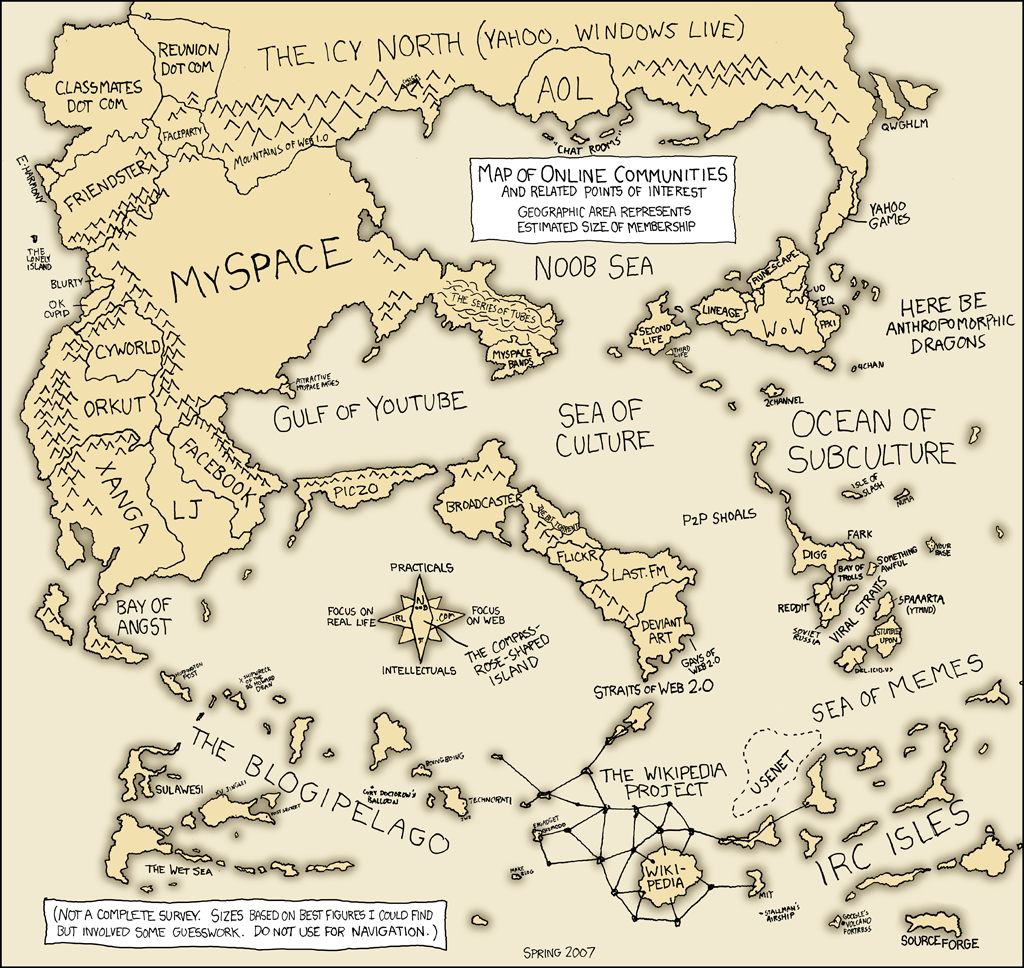
Map of online communities
Check out this really great map of online communities! The size of the geographic region is proportional to the estimated size of membership.

On Technorati: online communities, social networks
On Technorati: online communities, social networks
Thursday, April 26, 2007
China in the Age of the Internet talk
Today, there is a talk in the Munk Centre at U of T called China in the Age of the Internet being presented by Guo Liang from the Chinese Academy of Sciences. The use of Internet in China is huge now, with companies like Google and Yahoo setting up shop there. The largest search company so far in China before Google is Sina.com. Most Chinese researchers don't use qualitative or quantitative methods, but now the younger generation is using them. In fact, lots of people use the Internet for means of communication and getting information, which would otherwise be censored outside the Internet. The use of Internet is growing fast in China, right now there are 130 million users in China (however it is difficult to measure because people use Internet cafes). People can get access to the Internet using Internet cafes, which is about 3 RMB/hour in large cities and 1 RMB/hour in small towns which translates to about $1 CDN for 3 hours.
His methodology is based on the World Internet Project and China Internet Project. The China Internet Project is based on a door-to-door household based interview. His conceptual model looks into media use and how it influences internet use and internet access.
In the history of the Internet use in China in 2000, the early adopters were young, male, well educated, and well paid. E-mail was not heavily used, and 41.6% did not use search engines, the Internet was primarily used for games. It's interesting that 76% of Chinese users did not make purchases online. It seems that Internet is more of an entertainment highway as opposed to an information highway in the Western world. According to 2005 survey, Guo says that the #1 online activity is reading news, whereas in the UK it is reading e-mail.
So why it is that online purchasing is not so popular? Because credit cards are not prevalent in China and there isn't much content, and also lack of trust. Not many people use search engines in China.
From the 2005 survey that Guo did, he found that pornography, violence and junk messages should be controlled. One would expect that Internet control in China is political, when in fact it is social control. Another interesting thing is Internet search in China. Google started an office in China about 2 years ago in 2005 but still it is not as good or is used that much compared to Baidu. In fact, none of the US internet companies have been successful in China (Yahoo, Google, eBay, Amazon).
So why is Baidu better than Google? Because Baidu knows Chinese content and Google has not done good marketing in China. Google doesn't understand the Chinese market. Baidu apparently is a good portal and service to search for MP3s. The Chinese internet users also seem to communicate online with their friends and colleagues than face-to-face or physically with family by traditional means. As a result, it seems that building an online community would be more viable and easier than here in Western culture like the US and Canada. Chinese users also are favored to use online comments on news where people can leave comments on news articles and spur discussion. In fact, the top 2 country leaders and the Chinese president learned about SARS from the Internet. Internet can affect public opinion which can then change current regulations to become law.
Lots of people also talk about Internet censorship in China, like how some certain sites are blocked because of the type of content or the keywords used. In China, people have to register their personal ID to the police for the internet (but not all do). You can get a pre-paid Internet card to use the Internet. Even blocked sites can be accessed through proxy servers.
More information on Guo's papers and research can be found from China Internet Project.
On Technorati: China, China internet
His methodology is based on the World Internet Project and China Internet Project. The China Internet Project is based on a door-to-door household based interview. His conceptual model looks into media use and how it influences internet use and internet access.
In the history of the Internet use in China in 2000, the early adopters were young, male, well educated, and well paid. E-mail was not heavily used, and 41.6% did not use search engines, the Internet was primarily used for games. It's interesting that 76% of Chinese users did not make purchases online. It seems that Internet is more of an entertainment highway as opposed to an information highway in the Western world. According to 2005 survey, Guo says that the #1 online activity is reading news, whereas in the UK it is reading e-mail.
So why it is that online purchasing is not so popular? Because credit cards are not prevalent in China and there isn't much content, and also lack of trust. Not many people use search engines in China.
From the 2005 survey that Guo did, he found that pornography, violence and junk messages should be controlled. One would expect that Internet control in China is political, when in fact it is social control. Another interesting thing is Internet search in China. Google started an office in China about 2 years ago in 2005 but still it is not as good or is used that much compared to Baidu. In fact, none of the US internet companies have been successful in China (Yahoo, Google, eBay, Amazon).
So why is Baidu better than Google? Because Baidu knows Chinese content and Google has not done good marketing in China. Google doesn't understand the Chinese market. Baidu apparently is a good portal and service to search for MP3s. The Chinese internet users also seem to communicate online with their friends and colleagues than face-to-face or physically with family by traditional means. As a result, it seems that building an online community would be more viable and easier than here in Western culture like the US and Canada. Chinese users also are favored to use online comments on news where people can leave comments on news articles and spur discussion. In fact, the top 2 country leaders and the Chinese president learned about SARS from the Internet. Internet can affect public opinion which can then change current regulations to become law.
Lots of people also talk about Internet censorship in China, like how some certain sites are blocked because of the type of content or the keywords used. In China, people have to register their personal ID to the police for the internet (but not all do). You can get a pre-paid Internet card to use the Internet. Even blocked sites can be accessed through proxy servers.
More information on Guo's papers and research can be found from China Internet Project.
On Technorati: China, China internet
Monday, April 23, 2007
Toronto has largest Facebook network
Here's an interesting stat, from this blog entry
(http://ryanfeeley.com/2007/04/21/torontonians-surpass-12-million-mark-on-facebook/),
Toronto has the largest Facebook network, surpassing New York and
London, UK. I would have thought that San Francisco or San Jose (some
place in Silicon Valley) would surely beat us, since they're strongly
into online social networking and Web 2.0, but apparently we're
beating them in Facebook.
(http://ryanfeeley.com/2007/04/21/torontonians-surpass-12-million-mark-on-facebook/),
Toronto has the largest Facebook network, surpassing New York and
London, UK. I would have thought that San Francisco or San Jose (some
place in Silicon Valley) would surely beat us, since they're strongly
into online social networking and Web 2.0, but apparently we're
beating them in Facebook.
So, what does this mean for Toronto, does this mean that we're leading
the pack in social networking technologies and online social
networking? Does this mean, that Toronto lacks face-to-face and
social contact compared to other cities? Or, does this mean that
Toronto forms a more cohesive and larger social network and virtual
community than others because due its multiculturalism. What are some
factors that make this Facebook statistic?
It would be interesting to conduct a study analyzing Facebook in
Toronto and compare that with physical community in Toronto, and see
if due to the social fabric in Toronto, this is how the Facebook
network comes to be.
Alvin
Sunday, April 22, 2007
Jaiku vs. Twitter
 VS.
VS.
Well, it wasn't long that there was going to be another alternative to Twitter. That's what happens when something new comes along, there's going to be a rival to the first thing.
This new alternative is called Jaiku, and according to 606 Tech, this seems to be a force to be reckoned with. Apparently, I just found out that Leo Laporte has switched from Twitter to Jaiku. If you don't know Leo Laporte, he's the tech guy on Call for Help and also This Week In Tech (or otherwise known as TWiT), which I listen to his podcasts on my iPod.
So what's the difference between Jaiku and Twitter? Well according to the 606 Tech article, it is "the ease with which any feed can be added to your account, for your own purposes as well as your friends". This is part of the trend of online social behaviour. Think of Jaiku and Twitter as a blending between instant messaging and blogging. In a way, it's like a mini-blog because there are status updates in chronological order like a blog. In another way, it's like instant messaging because you can post messages to other friends and they can reply back. With Jaiku, you can read and post from your phone.
I haven't played around with Twitter or Jaiku, just for the fact that I too might be addicted!
On Technorati: Jaiku, Twitter
Friday, April 20, 2007
Presenting and volunteering at Pervasive 2007

I will be at the Pervasive 2007 conference which is in Toronto this year. Finally, I've always wanted to go to Pervasive but never had the chance to go to because it was too far away and too expensive. I will be presenting my doctoral research as part of the Doctoral Colloquium which is "The Search for Sense of Virtual Community in Social Hypertext". As well, I will also be a student volunteer at Pervasive, so if you're at Pervasive, you might see me running around the conference, or helping out at different sessions, or even socializing. Pervasive starts May 13 and runs to May 16. I'm really eager to help out and to be at this conference.
The keynote speaker is Adam Greenfield, who is the author of the Everyware: The Dawning Age of Ubiquitous Computing book. Adam will be talking about "Everyware: Some Social and Ethical Implications of Ubiquitous Computing". That's great, because I met Adam when he gave a talk in San Francisco last summer when I was working at PARC, you can see my blog post about him here.
Pervasive should be a great conference, and I'm looking forward to it!
On Technorati: Pervasive2007, Toronto, Ubiquitous Computing, pervasive computing, doctoral colloquium
Thursday, April 19, 2007
Escalating from small screens to large screens: Patrick Baudisch talk
Today is the talk in DCS from Patrick Baudisch from Microsoft Research. His talk is about escalating from small screens to large screens. The abstract of his talk is here.
Abstract
The range of available range of computing devices continues to grow.
One way of classifying these devices is by their display size,
ranging from smart personal objects, such as phones and watches to
wall-size displays. The new devices have the potential to radically
reshape the way we think and work. At this point, however, it is
still an open question how these devices will come together to create
that ubiquitous infrastructure.
In my vision, devices of different screen sizes will be joined into a
single "escalation" hierarchy: Whenever possible, users will use the
most available, least encumbering device. Only when the most
available device fails will users escalate to the next larger and
more powerful device. I envision a future in which many users will
conduct the vast majority of their information access on a device the
size of a mobile phone. On the other hand, users will escalate to
very large and powerful devices, such as multi-display systems or
wall displays, if complex sensemaking activities require them to.
In this talk, I present a framework of visualization and interaction
techniques that combines devices into a single integrated device
hierarchy. Its ultimate goal is to enable users to begin a thought
process on one device and to continue it on another one using a
single unified type of interaction.
Here are my notes that I made from the talk:
He is mentioning how the number of cell phones sold is more than the number of PCs. The mantra is to use the most available device, which is what ubiquitous computing is all about. However, the challenge is porting from a small screen to a large screen. Sometimes you want to see information displayed on a wall display instead on a tiny screen of a cell phone. In fact, many people like software developers have more than one monitor, and there was an article showing the performance benefits of having a larger screen. You want to have a consistent experience moving from a small screen to a large screen.
This type of research in my opinion is called ambient computing. According to Patrick, what we want is to have high focus in the core and low resolution in the periphery vision. Only content physically close to the user can be perceived in full vision, therefore the human is the limiting factor. Patrick showed a demo called drag and pop, which allows users to drag files to folders on the desktop but it will highlight those possible folders, without having the user to physically use the mouse to drag to the actual folder. Therefore, this concept is using focus + context interaction which is to bring the content to the user, let the user interact with it, and send the content back. This especially applies to large displays, because you don't want to have users to be fatigued with their body parts like moving their arms or walking across the display.
This then begs the question, is this going to make users more lazy? Witness the success of the Nintendo Wii because it allows users to move and do some exercise interacting with the games. For small displays, we also want focus + context, but the context is imaginary. For example, he showed a demo of a mapping application on a Compaq iPaq handheld, where arcs are used (called halo rings) to indicate that there are locations of interest for the user.
In summary, human factors cause large screens to fall apart into focus and context, and interaction. By the way, Patrick's talk in PPT form is right here.
On Technorati: Patrick Baudisch, small screens, large screens
Abstract
The range of available range of computing devices continues to grow.
One way of classifying these devices is by their display size,
ranging from smart personal objects, such as phones and watches to
wall-size displays. The new devices have the potential to radically
reshape the way we think and work. At this point, however, it is
still an open question how these devices will come together to create
that ubiquitous infrastructure.
In my vision, devices of different screen sizes will be joined into a
single "escalation" hierarchy: Whenever possible, users will use the
most available, least encumbering device. Only when the most
available device fails will users escalate to the next larger and
more powerful device. I envision a future in which many users will
conduct the vast majority of their information access on a device the
size of a mobile phone. On the other hand, users will escalate to
very large and powerful devices, such as multi-display systems or
wall displays, if complex sensemaking activities require them to.
In this talk, I present a framework of visualization and interaction
techniques that combines devices into a single integrated device
hierarchy. Its ultimate goal is to enable users to begin a thought
process on one device and to continue it on another one using a
single unified type of interaction.
Here are my notes that I made from the talk:
He is mentioning how the number of cell phones sold is more than the number of PCs. The mantra is to use the most available device, which is what ubiquitous computing is all about. However, the challenge is porting from a small screen to a large screen. Sometimes you want to see information displayed on a wall display instead on a tiny screen of a cell phone. In fact, many people like software developers have more than one monitor, and there was an article showing the performance benefits of having a larger screen. You want to have a consistent experience moving from a small screen to a large screen.
This type of research in my opinion is called ambient computing. According to Patrick, what we want is to have high focus in the core and low resolution in the periphery vision. Only content physically close to the user can be perceived in full vision, therefore the human is the limiting factor. Patrick showed a demo called drag and pop, which allows users to drag files to folders on the desktop but it will highlight those possible folders, without having the user to physically use the mouse to drag to the actual folder. Therefore, this concept is using focus + context interaction which is to bring the content to the user, let the user interact with it, and send the content back. This especially applies to large displays, because you don't want to have users to be fatigued with their body parts like moving their arms or walking across the display.
This then begs the question, is this going to make users more lazy? Witness the success of the Nintendo Wii because it allows users to move and do some exercise interacting with the games. For small displays, we also want focus + context, but the context is imaginary. For example, he showed a demo of a mapping application on a Compaq iPaq handheld, where arcs are used (called halo rings) to indicate that there are locations of interest for the user.
In summary, human factors cause large screens to fall apart into focus and context, and interaction. By the way, Patrick's talk in PPT form is right here.
On Technorati: Patrick Baudisch, small screens, large screens
Wednesday, April 18, 2007
The computer version of the Lord's Prayer
If you're Christian, you know about and recite the Lord's Prayer. Well, here is a version of that prayer translated into computer terminology. It's quite hilarious and comes from John Barry in 1993. It goes like this:
(funny that it comes from the ACM Review web site!)
The Computer Person’s Prayer
Our program, who art in Memory,
Hello be thy name.
Thy Operating System come,
thy commands be done,
at the Printer as they are on the Screen.
Give us this day our daily data,
and forgive us our I/O Errors as we forgive those whose Logic Circuits are faulty.
Lead us not into Frustration,
and deliver us from Power Surges.
For thine is the Algorithm,
The Application,
and the Solution,
looping forever and ever.
Return.
On Technorati: computer, Christianity
(funny that it comes from the ACM Review web site!)
The Computer Person’s Prayer
Our program, who art in Memory,
Hello be thy name.
Thy Operating System come,
thy commands be done,
at the Printer as they are on the Screen.
Give us this day our daily data,
and forgive us our I/O Errors as we forgive those whose Logic Circuits are faulty.
Lead us not into Frustration,
and deliver us from Power Surges.
For thine is the Algorithm,
The Application,
and the Solution,
looping forever and ever.
Return.
On Technorati: computer, Christianity
What's so great about Twitter, maybe this video might be the answer
There is a video by Evan Williams of Twitter, explaining about Twitter, that might explain what is so great about Twitter from the ICWSM 2007 (International Conference on Weblogs and Social Media) conference this year.
According to Evan, Twitter is about a sense of connection and is in a way a kind of blogging tool. Kind of like a mini-blog since each Twitter post is up to 140 characters, like SMS.
On Technorati: Twitter
According to Evan, Twitter is about a sense of connection and is in a way a kind of blogging tool. Kind of like a mini-blog since each Twitter post is up to 140 characters, like SMS.
On Technorati: Twitter
Tuesday, April 17, 2007
Zude: Swiss army knife of the social web?
I found this really interesting video about Zude, a web site that reminds me of a mashup. This came from CNET after I watched the video about Stanford displaying some new technology from Stanford University's annual Cool Products Expo, me being the gadget man as I am. Zude is a product that comes from Fifth Generation Systems. It's not out yet, it comes out May 1 of this year. It touts itself as "easiest and most powerful way to express yourself on the web. It is both an enhancement to the myspace's of the world as well as the next generation and ultimate evolution of web interaction -- and so much more", according to their web site.
That's a really tall order, in my opinion. This really just sounds like a mashup, which really is nothing new. I think what they're trying to say is that it is kind of a mashup, but for the end user, they don't have to write any code, whereas right now, you need to know the API of the other system that you want to add to your mashup. I've just registered, so I'll see exactly how this works and if it's something that maybe I can use. Oh and by the way, Zude kinda sounds very close to Zune, Microsoft's MP3 iTunes wannabe player, just thought I wanted to say that.
On Technorati: Zude
That's a really tall order, in my opinion. This really just sounds like a mashup, which really is nothing new. I think what they're trying to say is that it is kind of a mashup, but for the end user, they don't have to write any code, whereas right now, you need to know the API of the other system that you want to add to your mashup. I've just registered, so I'll see exactly how this works and if it's something that maybe I can use. Oh and by the way, Zude kinda sounds very close to Zune, Microsoft's MP3 iTunes wannabe player, just thought I wanted to say that.
On Technorati: Zude
Thursday, April 12, 2007
DCS talk: Adrien Treuille from U of Washington
Today there is a talk from Adriene Treuille from University of Washington called "New approaches to modeling and control of complex dynamics". Abstract of his talk is below.
Complex phenomena such as animal morphology, human motion, and large
fluid systems challenge even our most sophisticated simulation and
control techniques. My overarching research goal has been to develop
fundamentally new methods to approach such high-dimensional and
nonlinear problems. This talk presents my work solving these problems
across a wide range of phenomena, including a new model-reduction
approach to fluids that is orders-of-magnitude faster than standard
simulation methods and enables interactive high-resolution fluid
simulation for the first time. Another example is a continuum
approach to crowd dynamics which efficiently reproduces empirical
aspects of large crowd behavior that would be difficult or impossible
to achieve with traditional agent models. The talk will also cover
work on several other phenomena including human animation, animal
morphology, and protein folding. Such new algorithmic approaches
advance not only our ability to simulate and control complex systems
but also our understanding of the systems themselves.
Bio: Adrien Treuille is a Ph.D. candidate in the Department of
Computer Science and Engineering at the University of Washington. He
received a M.S. degree in Computer Science from the University of
Washington, and a B.S. degree in Computer Science from Georgetown
University. Adrien's research interests include computer graphics,
optimization, model reduction, control, biomechanics, and recently,
biochemistry.
What seems fascinating about his talk is the modeling of crowds like for example how crowds form in metropolitan cities, and how this can be mathematically simulated which closely resembles what naturally happens. Also, what was really cool was how he modelled and showed a simulation of human motion. Even though graphics is not really my research area, it's just neat to see how graphics works.
Complex phenomena such as animal morphology, human motion, and large
fluid systems challenge even our most sophisticated simulation and
control techniques. My overarching research goal has been to develop
fundamentally new methods to approach such high-dimensional and
nonlinear problems. This talk presents my work solving these problems
across a wide range of phenomena, including a new model-reduction
approach to fluids that is orders-of-magnitude faster than standard
simulation methods and enables interactive high-resolution fluid
simulation for the first time. Another example is a continuum
approach to crowd dynamics which efficiently reproduces empirical
aspects of large crowd behavior that would be difficult or impossible
to achieve with traditional agent models. The talk will also cover
work on several other phenomena including human animation, animal
morphology, and protein folding. Such new algorithmic approaches
advance not only our ability to simulate and control complex systems
but also our understanding of the systems themselves.
Bio: Adrien Treuille is a Ph.D. candidate in the Department of
Computer Science and Engineering at the University of Washington. He
received a M.S. degree in Computer Science from the University of
Washington, and a B.S. degree in Computer Science from Georgetown
University. Adrien's research interests include computer graphics,
optimization, model reduction, control, biomechanics, and recently,
biochemistry.
What seems fascinating about his talk is the modeling of crowds like for example how crowds form in metropolitan cities, and how this can be mathematically simulated which closely resembles what naturally happens. Also, what was really cool was how he modelled and showed a simulation of human motion. Even though graphics is not really my research area, it's just neat to see how graphics works.
Wednesday, April 11, 2007
My blog gets redirected to Blogarithm broken domain
Yesterday, I wanted to write a post about how for some particular reason, if you were to go to my blog, it would automatically get redirected to Blogarithm.com. But when you go to Blogarithm.com, it would come up with the following error message saying that the Blogarithm domain expired:

At first, I thought it had to do with the post I wrote about Blogarithm, and so the Blogarithm web site got redirected because I might have clicked on the link. Then, I thought maybe I had some spyware on my computer. I tried closing Firefox and opening it, but it still redirected to the Blogarithm error page. Then, I tried using Internet Explorer, and I still got redirected. Failing that, I decided to try going to my blog from my desktop computer and still got redirected. I didn't quite understand last night why I got redirected. Then, I went to my blog today and it was fine. Then I realized that I got redirected because on the sidebar in my blog, I have a embedded script that connects to Blogarithm.com which tells what other blogs that the blog readers have also read.
Anyways, the Blogarithm problem appears to have been fixed now. For a moment, I thought that the entire Blogarithm service was out of service for good! Phew, that was a little scare, but it's ok now.
On Technorati: Blogarithm
At first, I thought it had to do with the post I wrote about Blogarithm, and so the Blogarithm web site got redirected because I might have clicked on the link. Then, I thought maybe I had some spyware on my computer. I tried closing Firefox and opening it, but it still redirected to the Blogarithm error page. Then, I tried using Internet Explorer, and I still got redirected. Failing that, I decided to try going to my blog from my desktop computer and still got redirected. I didn't quite understand last night why I got redirected. Then, I went to my blog today and it was fine. Then I realized that I got redirected because on the sidebar in my blog, I have a embedded script that connects to Blogarithm.com which tells what other blogs that the blog readers have also read.
Anyways, the Blogarithm problem appears to have been fixed now. For a moment, I thought that the entire Blogarithm service was out of service for good! Phew, that was a little scare, but it's ok now.
On Technorati: Blogarithm
CODE: Building the new AGORA - Social formations in the age of NextWeb
Today is a panel discussion about the social formations in the age of NextWeb, which is the second part of the CODE: Building the new Agora event. Last night was Wendy Chun's lecture on Open-imagined networks which I blogged about yesterday. It's nice to see a lot of people at this event to discuss about Web 2.0 and social computing. One of the panels is a group from BarCamp Toronto. Some of the representatives from TorCamp here today are Mark Kuznicki and David Crowe. It's a tight night group here, where everybody is sitting in a circle. Right now, everybody is giving a blurb about themselves.
Now, David Crowe is talking about what BarCamp is about, BarCamp is about the connections between people, it is called an "unconference" where there is no set schedule. It's about making connections in a shared environment. You can't build community, community just forms around shared ideas, around connections and events. It's about how to provide tools and systems to people. So the question is about whether community is an organization. The community is built from the bottom and up and is run by individuals not a group of people, so any individual can step up to the plate and contribute to the community. The tools are making the implicit networks become explicit. The community is open, meaning anyone can enter. BarCamp was a reaction to invite-only conferences. One of the things that I brought about is how BarCamp is now applying their expertise in technology to solve society's problems. TransitCamp was created in Toronto by BarCamp in reaction to tackling the TTC's problems in Toronto. What we have in Toronto is closed technologists, who don't really communicate with each other and share, like in Silicon Valley, therefore this is what BarCamp arose from to enable more collaboration and openness. BarCamp can be thought of as a disruptive way of conferences, similar to disruptive technologies (like peer-to-peer) compared to mainstream technologies (like client/server).
The second group is Upgrade which is a group of people that deal with network media and artists and present the work of media artists. There are now 26 nodes of Upgrade worldwide. I've never heard of Upgrade before until today. There really is no structure behind Upgrade, it is broad fusing between technology and the arts like electronic music, arts made with computers. Each particular node is local, but are global.
One of the panel speakers is talking about the Mozilla community and he is a college professor teaching open-source software. And how he is mentoring students as to which people to talk to for writing code, so writing software is about fostering relationships, it's all about social networks. Most software developers meet on IRC where they can talk and listen, but the problem with IRC is that you can't really listen.
The second panel discussion is on Clearing, which is in reaction to a recognition of scarcity of time, a desire to grow and manage identity, and build community. The goals of Clearing are similar to BarCamp, but is like a village. It is being moderated by Jesse Hirsch of Open Flows. The group is organized and communicates through a wiki. There are no lurkers in this group to help facilitate contribution from among everyone in the group. The group arose in response to dissatisfaction with conversations around Web 2.0. There is this group called Juice (I think that's how it is spelled) which was designed to gather a diverse group of people that would never get together, and try to form some interest. There is an intentionality of bringing the periphery to the center, as opposed to starting from a group of people in the center (the A-list) and have other people connect from the center. So, this is kind of like a bottom-up approach. This is quite interesting because when in my research, I was trying to build community around the independent music blog, it was quite difficult, because there was that pressure to provide compelling content and something to say, that would make people go to the blog and start commenting and create conversations as a result of it.
Anyways, very interesting stuff. I wonder if there will be a blog or some kind of communication channel to continue what was discussed today?
On Technorati: CODE-Agora
Now, David Crowe is talking about what BarCamp is about, BarCamp is about the connections between people, it is called an "unconference" where there is no set schedule. It's about making connections in a shared environment. You can't build community, community just forms around shared ideas, around connections and events. It's about how to provide tools and systems to people. So the question is about whether community is an organization. The community is built from the bottom and up and is run by individuals not a group of people, so any individual can step up to the plate and contribute to the community. The tools are making the implicit networks become explicit. The community is open, meaning anyone can enter. BarCamp was a reaction to invite-only conferences. One of the things that I brought about is how BarCamp is now applying their expertise in technology to solve society's problems. TransitCamp was created in Toronto by BarCamp in reaction to tackling the TTC's problems in Toronto. What we have in Toronto is closed technologists, who don't really communicate with each other and share, like in Silicon Valley, therefore this is what BarCamp arose from to enable more collaboration and openness. BarCamp can be thought of as a disruptive way of conferences, similar to disruptive technologies (like peer-to-peer) compared to mainstream technologies (like client/server).
The second group is Upgrade which is a group of people that deal with network media and artists and present the work of media artists. There are now 26 nodes of Upgrade worldwide. I've never heard of Upgrade before until today. There really is no structure behind Upgrade, it is broad fusing between technology and the arts like electronic music, arts made with computers. Each particular node is local, but are global.
One of the panel speakers is talking about the Mozilla community and he is a college professor teaching open-source software. And how he is mentoring students as to which people to talk to for writing code, so writing software is about fostering relationships, it's all about social networks. Most software developers meet on IRC where they can talk and listen, but the problem with IRC is that you can't really listen.
The second panel discussion is on Clearing, which is in reaction to a recognition of scarcity of time, a desire to grow and manage identity, and build community. The goals of Clearing are similar to BarCamp, but is like a village. It is being moderated by Jesse Hirsch of Open Flows. The group is organized and communicates through a wiki. There are no lurkers in this group to help facilitate contribution from among everyone in the group. The group arose in response to dissatisfaction with conversations around Web 2.0. There is this group called Juice (I think that's how it is spelled) which was designed to gather a diverse group of people that would never get together, and try to form some interest. There is an intentionality of bringing the periphery to the center, as opposed to starting from a group of people in the center (the A-list) and have other people connect from the center. So, this is kind of like a bottom-up approach. This is quite interesting because when in my research, I was trying to build community around the independent music blog, it was quite difficult, because there was that pressure to provide compelling content and something to say, that would make people go to the blog and start commenting and create conversations as a result of it.
Anyways, very interesting stuff. I wonder if there will be a blog or some kind of communication channel to continue what was discussed today?
On Technorati: CODE-Agora
Tuesday, April 10, 2007
CODE lecture: Wendy Chun on Open Source Imagined Networks
Tonight, there is a lecture part of CODE which is a follow-up to NextWeb, which I attended about Web 2.0 technologies. What is CODE? This comes from the Project Open Source|Open Access initiative at KMDI.
CODE: Project Open Source|Open Access at the Knowledge Media Design Institute brings you Building the New Agora, an exploration of current perspectives on the contemporary perception of hardware/software and investigates how open source/open access alters our approaches to professional and social networks. Less than five years ago the cultural theorist Lev Manovich claimed that while the 1990s were all about the virtual, the next decade might be about physical space and interactions, albeit augmented by electronic information.
Tonight's lecture is by Wendy Chun of Brown University. This is the abstract of her talk.
The motivation behind the open source software movement has often been discussed in terms of a "gift economy" or pleasure ("just for the fun of it"). Drawing from Benedict Anderson's analysis of the nation as an "imagined community," Chun will argue for the open source movement and other glocal phenomena as "imagined networks." In doing so, she does not argue for the distributed network as the model for our social interactions, bureaucratic organizations, or even our technologies, but rather asks: what needs to be in place for us to understand ourselves and our technologies as networked? How do social and technological abstractions coincide, diverge and inform each other? and how are these abstractions experienced, sensed, felt?
Wendy is looking at the social phenomenon of the open source movement. She is working on this initiative called "open source imagined networks" and code building the new agora. So, I've never really heard of code being called "building a new agora". According to Wendy, it's about involving users and machines in constant and insecure interchanges. Open and public is not synonymous. Building the new agora also raises other questions, agora is not just a public space or marketplace, it is an assembly, this reminds me of the bazaar and cathedral analogy that Richard Stallman talks about when discussing open source software.
Software is a form of enlightenment, the base layer or logic of new media. According to Lev Manovich, new media needs to look to computer science to characterize media that become programmable. Yeah, this shows that computer science permeates society! The essence of software is now becoming philosophical and psychological. What does software do? OED defines software as the programs and procedures required to enable a computer to perform a specific task, as opposed to the physical components of the system. Software blurs the difference, taking the process in time into process in space, turning words into action.
She is now talking about how goto statements complicates the process into command, gotos make it difficult to make the source program to act as a legible source. Gotos also make for "spaghetti code" which every programmer learns when first coding (at least if you're using a programming language that uses gotos like BASIC). So what is code? Code is the first language that actually does what it says - it is a machine for converting meaning into action. Code is the only language that is executable. Source code only becomes source after the fact, so really source is "re-source". According to Wendy, hardware does not require software, for example we can implement conditional branching using gates.
To know the code, is to know that the inside is connected to the outside. This is the first time I've heard the philosophical nature of software, the lecture sounds like one of those philosophy lectures. She is now talking about social interactions with networks. Facebook is social networking software, part of Web 2.0. According to her, Web 2.0 is an imagined network. Facebook provides the interactions for students online. With social network software, we are trying to create cognitive maps.
CODE: Project Open Source|Open Access at the Knowledge Media Design Institute brings you Building the New Agora, an exploration of current perspectives on the contemporary perception of hardware/software and investigates how open source/open access alters our approaches to professional and social networks. Less than five years ago the cultural theorist Lev Manovich claimed that while the 1990s were all about the virtual, the next decade might be about physical space and interactions, albeit augmented by electronic information.
Tonight's lecture is by Wendy Chun of Brown University. This is the abstract of her talk.
The motivation behind the open source software movement has often been discussed in terms of a "gift economy" or pleasure ("just for the fun of it"). Drawing from Benedict Anderson's analysis of the nation as an "imagined community," Chun will argue for the open source movement and other glocal phenomena as "imagined networks." In doing so, she does not argue for the distributed network as the model for our social interactions, bureaucratic organizations, or even our technologies, but rather asks: what needs to be in place for us to understand ourselves and our technologies as networked? How do social and technological abstractions coincide, diverge and inform each other? and how are these abstractions experienced, sensed, felt?
Wendy is looking at the social phenomenon of the open source movement. She is working on this initiative called "open source imagined networks" and code building the new agora. So, I've never really heard of code being called "building a new agora". According to Wendy, it's about involving users and machines in constant and insecure interchanges. Open and public is not synonymous. Building the new agora also raises other questions, agora is not just a public space or marketplace, it is an assembly, this reminds me of the bazaar and cathedral analogy that Richard Stallman talks about when discussing open source software.
Software is a form of enlightenment, the base layer or logic of new media. According to Lev Manovich, new media needs to look to computer science to characterize media that become programmable. Yeah, this shows that computer science permeates society! The essence of software is now becoming philosophical and psychological. What does software do? OED defines software as the programs and procedures required to enable a computer to perform a specific task, as opposed to the physical components of the system. Software blurs the difference, taking the process in time into process in space, turning words into action.
She is now talking about how goto statements complicates the process into command, gotos make it difficult to make the source program to act as a legible source. Gotos also make for "spaghetti code" which every programmer learns when first coding (at least if you're using a programming language that uses gotos like BASIC). So what is code? Code is the first language that actually does what it says - it is a machine for converting meaning into action. Code is the only language that is executable. Source code only becomes source after the fact, so really source is "re-source". According to Wendy, hardware does not require software, for example we can implement conditional branching using gates.
To know the code, is to know that the inside is connected to the outside. This is the first time I've heard the philosophical nature of software, the lecture sounds like one of those philosophy lectures. She is now talking about social interactions with networks. Facebook is social networking software, part of Web 2.0. According to her, Web 2.0 is an imagined network. Facebook provides the interactions for students online. With social network software, we are trying to create cognitive maps.
Monday, April 09, 2007
The top 5 most wanted gadgets
Thursday, April 05, 2007
Big laptop at Union Station
Yesterday morning, I saw a huge laptop powered with the Intel Core Duo processor as advertisement in the center of Union Station on my way to school. So, naturally, I took a picture on my camera cell phone

I went near the laptop and touched it, but the keys were not real, it was just flat.
This morning, the laptop wasn't there anymore.
On Technorati: intel, Union Station, GO train, laptop
I went near the laptop and touched it, but the keys were not real, it was just flat.
This morning, the laptop wasn't there anymore.
On Technorati: intel, Union Station, GO train, laptop


Wednesday, April 04, 2007
OK, what is so great about Twitter?
I've heard about this new thing called Twitter which allows you to write short posts of what you're doing so that others who subscribe to you, can message you back, and you can show the things you are doing publicly. Kind of like what Facebook does when you login, you can see the status of people and what they are doing.
It seems that everyone is Twittering, Leo Laporte, who is the host of This Week in Tech, which I listen to the podcasts, Father Roderick from the Daily Breakfast, AccordionGuy (Joey DeVilla), it seems everyone is getting into Twitter. But what is so good about Twitter? I just see as a simple chat/blog, it's nothing really new, and just see it as another distraction. What's the value of using Twitter? I suppose if I want to let people know what I am doing or what I did, instead of writing it on a blog where everyone would read it, I can only have a network of my friends see it, rather than messaging, where I have to have everyone connect to MSN.
Can someone explain to me what exactly is Twitter and how it differs than other technologies that we have? What's the value with Twitter?
On Technorati: Twitter
It seems that everyone is Twittering, Leo Laporte, who is the host of This Week in Tech, which I listen to the podcasts, Father Roderick from the Daily Breakfast, AccordionGuy (Joey DeVilla), it seems everyone is getting into Twitter. But what is so good about Twitter? I just see as a simple chat/blog, it's nothing really new, and just see it as another distraction. What's the value of using Twitter? I suppose if I want to let people know what I am doing or what I did, instead of writing it on a blog where everyone would read it, I can only have a network of my friends see it, rather than messaging, where I have to have everyone connect to MSN.
Can someone explain to me what exactly is Twitter and how it differs than other technologies that we have? What's the value with Twitter?
On Technorati: Twitter
Tuesday, April 03, 2007
Passed the PhD research proposal!
I just completed my PhD research proposal meeting today and passed. Next step is the thesis proposal which will be in September!
Monday, April 02, 2007
Google TiSP
Google just announced a new product on April 1, 2007 called the Google TiSP. It's a new in-home wireless broadband service.
What will Google think of next?
On Technorati: Google TiSP
What will Google think of next?
On Technorati: Google TiSP
Sunday, April 01, 2007
Why you shouldn't totally trust Google Maps for trips
Let's say you want to go on a trip from Toronto to London, UK (not London, Ontario), and you type this in Google Maps. The result will seem surprising.

Click the map above to see what Google Maps gives you as the directions. Pay attention to step #26.
Thanks to TorCamp for providing this information. At first, I thought it was an April Fools Day joke, but apparently it's legit.
On Technorati: Google Maps, Toronto to London, TorCamp
Click the map above to see what Google Maps gives you as the directions. Pay attention to step #26.
Thanks to TorCamp for providing this information. At first, I thought it was an April Fools Day joke, but apparently it's legit.
On Technorati: Google Maps, Toronto to London, TorCamp
Thursday, March 29, 2007
Hearing blogs: literally

One of the things that is very time consuming is reading blogs. Even though I subscribe through Blogarithm's service, which e-mails me the list of blogs that have been updated, I don't read all of them since I'm so busy working on PhD research and other stuff. However, I listen to my iPod mini all the time in between transit from school and home. So, wouldn't it be great to translate all the blog feeds that I read into MP3 and then subscribe them in iTunes? Well, this is what Talkr is all about, you've heard of Flickr for photos, frappr for mapping photos onto location. It seem the next thing is adding the r at the end of a word, even Motorola is doing it with their cell phones like Razr, Krzr, and now I've heard of the Lazr. What's with the 'r' phenomenon? First, we had the 'e' as in e-services, e-government, e-mail, etc., then the 'i' that Apple started with iPod, iTunes, iMovie, iRaq, iRan (ok you have to see the YouTube video on this, to understand what I'm talking about). It looks like we're not continuing the vowels, but now the consonants.
Anyways, back to what I wanted to say. I was just reading the KMDI newsletter which I subscribe to (and manage to find some interesting and fascinating stuff), and came across this Talkr service which allows you to translate text from blog feeds into MP3 audio. I thought that's great! That's what I need. So naturally, I decided to just try this out with my own blog feed. Anticipating, I'll be able to hear my own blog posts, I heard nothing, it didn't seem to work. So, I decided to try it out with Talkr's own blog feed. You can hear it here. But as you can hear, it still sounds not quite good, at least not as good as a regular podcast, because they're using some computer-generated voice to talk based on the translation of text.
I don't think I could hear that on my iPod, there's something if a person doesn't sound that good on a podcast, that really bothers me when I listen.
Still an interesting service though.
On Technorati: Talkr, voice, text, audioblog
DCS seminar: Gillian Hayes from Georgia Tech
Today, there is a talk from Gillian Hayes at Georgia Tech. She is talking about Support and Surveillance: Audio and Video Recording in Daily Life. I've noticed that her supervisor is Gregory Abowd who is doing work in context-aware computing. Abstract of her talk is here.
Capturing information is too much work and hard, a lot of times I know that I want to record stuff in my life using my camera and video, and it definitely is not trivial and can be cumbersome. Her work deals with how to do selective archiving of audio and video. This relates to a project that Microsoft Research is doing which is MyLifeBits from Gordon Bell.
One study that she is looking at has to deal with how to use technology to help autism patients. Right now, paper forms have to be done for record keeping of the autistic child's behaviour. Therefore, the recording and capture has to be made really simple. This was tested out in a school deployment and every teacher completed successful assessment with minimum amount of training. In this system, teachers were able to still get access to the data if they were to miss the incident. One concern is that it took longer to review the data, because the teachers had to spend the time to view the video. Teachers felt in control because they were part of the analytic process.
Another study looked into the acceptability of selective archiving in an informal space, which formed the BufferWare project.
The objectives of the case studies dealt with the tension points for users when doing selective archiving and capturing of audio and video. For example, who owns the data? Another question has to deal with when to record, and if recording, is this a potential risk? Does it become a technology for self-monitoring? Therefore, there can be an element of intrusiveness of the technology. As a result, acceptability of the technology requires understanding and trust.
Selective archiving is an appropriate and adoptable approach for functional behaviour assessment. One of the things she is looking into is the effects of selective archiving and capturing on collaborative publishing and editing. You see this with YouTube where people record and post videos, but they don't really collaborate on them. But all these case studies had technology built into the space, what about the technology in a mobile setting? Gillian and others created the Personal Audio Loop, where you would be able to record audio at a particular point in time and find it.
One of the things that I'm curious to know is this. These are specific case studies where the technology is deployed in the environment for capturing and recording. What about for the average individual, for example, going on a trip? Are there concepts, design elements from these studies that could be applied for selective archiving for the average person? And how could something like this be incorporated into a blog?
Capturing information is too much work and hard, a lot of times I know that I want to record stuff in my life using my camera and video, and it definitely is not trivial and can be cumbersome. Her work deals with how to do selective archiving of audio and video. This relates to a project that Microsoft Research is doing which is MyLifeBits from Gordon Bell.
One study that she is looking at has to deal with how to use technology to help autism patients. Right now, paper forms have to be done for record keeping of the autistic child's behaviour. Therefore, the recording and capture has to be made really simple. This was tested out in a school deployment and every teacher completed successful assessment with minimum amount of training. In this system, teachers were able to still get access to the data if they were to miss the incident. One concern is that it took longer to review the data, because the teachers had to spend the time to view the video. Teachers felt in control because they were part of the analytic process.
Another study looked into the acceptability of selective archiving in an informal space, which formed the BufferWare project.
The objectives of the case studies dealt with the tension points for users when doing selective archiving and capturing of audio and video. For example, who owns the data? Another question has to deal with when to record, and if recording, is this a potential risk? Does it become a technology for self-monitoring? Therefore, there can be an element of intrusiveness of the technology. As a result, acceptability of the technology requires understanding and trust.
Selective archiving is an appropriate and adoptable approach for functional behaviour assessment. One of the things she is looking into is the effects of selective archiving and capturing on collaborative publishing and editing. You see this with YouTube where people record and post videos, but they don't really collaborate on them. But all these case studies had technology built into the space, what about the technology in a mobile setting? Gillian and others created the Personal Audio Loop, where you would be able to record audio at a particular point in time and find it.
One of the things that I'm curious to know is this. These are specific case studies where the technology is deployed in the environment for capturing and recording. What about for the average individual, for example, going on a trip? Are there concepts, design elements from these studies that could be applied for selective archiving for the average person? And how could something like this be incorporated into a blog?
Tuesday, March 27, 2007
PhD research proposal document done!
I've just finished writing and sending my PhD research proposal to my commitee, which is the second part of my PhD checkpoints in Computer Science at U of T. My research proposal meeting will be on April 3.
Yes, finally done this part!
Yes, finally done this part!
Monday, March 26, 2007
PhD research proposal
Apologies if I have not been blogging lately, but I've been quite busy finishing up on the PhD research proposal which will lead towards my thesis proposal. Lots of late nights, but it's nice to see that my previous papers and research are beginning to cohesively come together as a PhD thesis. Finally, I see the light at the end of the tunnel, and the PhD journey will hopefully be finished by the end of this year or early next year.
On Technorati: research proposal
On Technorati: research proposal
Thursday, March 22, 2007
Tapan Parikh talk at CS at U of T
Tapan is giving a talk about Designing Appropriate Computing Technologies for the Rural Developing World, he is from the University of Washington.
Here is his abstract and bio:
Globalization has seen an increase in disparity between developed and
undeveloped regions. Disproportionate access to information
technology is a symptom and a factor contributing to this disparity.
In particular, people living in the rural developing world have many
information needs that could, but are not, being met by IT.
Technology for this context must be low-cost, accessible and
appropriate given the local infrastructure, including conditions of
intermittent power and connectivity. In this talk, I describe my
experiences developing CAM - a toolkit for mobile phone data
collection for the rural developing world. Designing technologies for
an unfamiliar context requires understanding the needs and
capabilities of potential users. Drawing from the results of an
extended design study conducted with microfinance group members in
rural India (many of whom are semi-literate or illiterate), I outline
a set of user interface design guidelines for accessibility to such
users. The results of this study are used to inform the design of
CAM, a mobile phone application toolkit including support for
paper-based interaction; multimedia input and output; and
disconnected operation. I provide evidence of CAM's usability,
breadth, and real-world applicability. Regarding real-world
applicability, a CAM application for microfinance data collection is
now being used by 17 NGO (non-governmental organization) to serve
over 10000 group members in two states of India. Regarding breadth, I
list some important rural data collection applications - including
for retail supply chain tracking, agricultural monitoring and health
care - that we have implemented, or can be implemented, using the CAM
toolkit. I conclude by discussing possible topics for future work and
my long-term research vision.
Bio: Tapan S. Parikh is an Intel Fellow and Ph.D. Candidate in the
Department of Computer Science and Engineering at the University of
Washington. Earlier, he received a M.S. degree in Computer Science
from UW and a Sc.B. degree with Honors in Molecular Modeling from
Brown University. Tapan's research interests include human-computer
interaction (HCI), systems engineering and information and
communication technologies for development (ICTD).
This talk is interesting to me because it has great relevance to applying technology to the rural developing world, that the urban communities take for granted. How can we solve the problems in rural areas using a mobile phone solution that deals with understanding context. The first part is understanding the context through a study that he is talking about how to provide financial services to the poor using computer technology. This study was done in India. Information can be the bridge between the formal and the informal. There is a need to design a system to make it accessible to users, and geographic. How to design a user interface for rural users who are semi-literate or illiterate? There was a test with a group of users, where the group hired a person to record the data on paper and pen. Then the paper representation was then reproduced as a software prototype on a laptop. For user response, there was a wide gap for looking at the computer and how to use the mouse to move around the screen. So in his design, he used icon buttons. Users then started to gain confidence after playing around with the user interface and clicking on buttons which would output in local language audio. I found that pretty interesting that illiterate users were able to work with the system, I can't even get my parents to try to use a computer!
The second part is to actually build the system. The solution that he used was the mobile phone which has a numeric keypad, speakers and microphone, is battery-operated and low cost. The HCI research community uses paper user interfaces for prototyping and leverage affordances of paper in digital user interfaces. But these approaches have had limited impact, and rural developing world may be the killer application for paper user interfaces. He created CAM, an application toolkit for mobile phones which includes a CAM browser and CAM scripting language to interact with the forms. The phone is used to capture the audio and images from paper, and then can review it on the phone for the user. The paper form has specific images that are captured and is associated with a particular action. Here's the paper of this that he presented at UIST 2005. This paper form that has special images which is captured by the phone, reminds me of the work by Intel Research Cambridge UK that dealt with capturing concentric circles on paper (like bar codes) and those correspond to performing a particular action. This is pretty neat, then there is no need to have to deploy something like RFID tags, because this is a low cost solution, and all phones now include a camera.
So how does this work in the field? He is now explaining about how he evaluated CAM. His results showed that the users performed significantly better with audio than textual prompts. The system has been deployed in India and commercialized by Ekgaon Technologies. CAM can also be applied to other field areas like agricultural monitoring.
His future work is looking into building a toolkit on top of CAM that allows local people to build their own solutions, and provide them with the tools and application development resources. The rural development using computer technology is now a hot area in many research institutions like UC Berkeley, Princeton/UW/MSR, MSR India, MIT Media Lab (with Nicholas Negroponte's One Laptop per Child).
This is very interesting work, and he mentioned this motivates students and others to work on this to contribute to solving real world problems.
On Technorati: CAM, rural, cell phone, field work, HCI
Here is his abstract and bio:
Globalization has seen an increase in disparity between developed and
undeveloped regions. Disproportionate access to information
technology is a symptom and a factor contributing to this disparity.
In particular, people living in the rural developing world have many
information needs that could, but are not, being met by IT.
Technology for this context must be low-cost, accessible and
appropriate given the local infrastructure, including conditions of
intermittent power and connectivity. In this talk, I describe my
experiences developing CAM - a toolkit for mobile phone data
collection for the rural developing world. Designing technologies for
an unfamiliar context requires understanding the needs and
capabilities of potential users. Drawing from the results of an
extended design study conducted with microfinance group members in
rural India (many of whom are semi-literate or illiterate), I outline
a set of user interface design guidelines for accessibility to such
users. The results of this study are used to inform the design of
CAM, a mobile phone application toolkit including support for
paper-based interaction; multimedia input and output; and
disconnected operation. I provide evidence of CAM's usability,
breadth, and real-world applicability. Regarding real-world
applicability, a CAM application for microfinance data collection is
now being used by 17 NGO (non-governmental organization) to serve
over 10000 group members in two states of India. Regarding breadth, I
list some important rural data collection applications - including
for retail supply chain tracking, agricultural monitoring and health
care - that we have implemented, or can be implemented, using the CAM
toolkit. I conclude by discussing possible topics for future work and
my long-term research vision.
Bio: Tapan S. Parikh is an Intel Fellow and Ph.D. Candidate in the
Department of Computer Science and Engineering at the University of
Washington. Earlier, he received a M.S. degree in Computer Science
from UW and a Sc.B. degree with Honors in Molecular Modeling from
Brown University. Tapan's research interests include human-computer
interaction (HCI), systems engineering and information and
communication technologies for development (ICTD).
This talk is interesting to me because it has great relevance to applying technology to the rural developing world, that the urban communities take for granted. How can we solve the problems in rural areas using a mobile phone solution that deals with understanding context. The first part is understanding the context through a study that he is talking about how to provide financial services to the poor using computer technology. This study was done in India. Information can be the bridge between the formal and the informal. There is a need to design a system to make it accessible to users, and geographic. How to design a user interface for rural users who are semi-literate or illiterate? There was a test with a group of users, where the group hired a person to record the data on paper and pen. Then the paper representation was then reproduced as a software prototype on a laptop. For user response, there was a wide gap for looking at the computer and how to use the mouse to move around the screen. So in his design, he used icon buttons. Users then started to gain confidence after playing around with the user interface and clicking on buttons which would output in local language audio. I found that pretty interesting that illiterate users were able to work with the system, I can't even get my parents to try to use a computer!
The second part is to actually build the system. The solution that he used was the mobile phone which has a numeric keypad, speakers and microphone, is battery-operated and low cost. The HCI research community uses paper user interfaces for prototyping and leverage affordances of paper in digital user interfaces. But these approaches have had limited impact, and rural developing world may be the killer application for paper user interfaces. He created CAM, an application toolkit for mobile phones which includes a CAM browser and CAM scripting language to interact with the forms. The phone is used to capture the audio and images from paper, and then can review it on the phone for the user. The paper form has specific images that are captured and is associated with a particular action. Here's the paper of this that he presented at UIST 2005. This paper form that has special images which is captured by the phone, reminds me of the work by Intel Research Cambridge UK that dealt with capturing concentric circles on paper (like bar codes) and those correspond to performing a particular action. This is pretty neat, then there is no need to have to deploy something like RFID tags, because this is a low cost solution, and all phones now include a camera.
So how does this work in the field? He is now explaining about how he evaluated CAM. His results showed that the users performed significantly better with audio than textual prompts. The system has been deployed in India and commercialized by Ekgaon Technologies. CAM can also be applied to other field areas like agricultural monitoring.
His future work is looking into building a toolkit on top of CAM that allows local people to build their own solutions, and provide them with the tools and application development resources. The rural development using computer technology is now a hot area in many research institutions like UC Berkeley, Princeton/UW/MSR, MSR India, MIT Media Lab (with Nicholas Negroponte's One Laptop per Child).
This is very interesting work, and he mentioned this motivates students and others to work on this to contribute to solving real world problems.
On Technorati: CAM, rural, cell phone, field work, HCI
Wednesday, March 21, 2007
TorCHI meeting tonight at Autodesk Canada (formerly Alias)
Tonight, I attended the TorCHI meeting which was held at Autodesk Canada, where Alias used to be, before Alias got bought out by Autodesk. The talk tonight was by Gordon Kurtenbach, Director of Research at Autodesk. Before going into Autodesk, I took a pic of outside Autodesk below.

Here's what I got from the talk. I've always wondered why did Autodesk (which is into engineering design software, the famous product being AutoCAD) buy Alias? At the time (about 1 and half years ago), I didn't quite understand. After tonight's talk, now I understand why.
So, as I always do at talks, I whipped out my laptop and started making notes. I wanted to write this on the blog so I searched for an Internet connection. I got connected to One Zone but I couldn’t connect to the Internet so I’m writing this in Word. This is the talk by Gordon Kurtenbach as part of the TorCHI meeting for the month of March. Gordon is the mastermind behind marking menus, he has 21 patents, and won an Academy Award for Ryan. Autodesk bought Alias Wavefront over a year ago. Alias is well known for its Maya software which was used for making the computer generated characters for the Lord of the Rings. Beside movies, games are becoming very realistic as well as commercials.
Architecture is now doing rendering with 3D realism, to see what the thing they are building, before it gets built. The media tools are used to amplify the artist’s talents. The technologist should not turn into an artist and vice versa. The user interface needs to fit the skills of the user. So what is considered natural interface for the user? It really is relative to the person who is using it.
What is natural? What is intuitive? What do those terms mean? It means it is a knowing of what the user will do. Ben Schneiderman, Stu Card, and others were the ones that laid the background for graphical user interfaces. With a musician, practice is what you do to learn how to play an instrument. Gordon’s PhD thesis dealt with accelerating the practice of user interfaces from novice to expert.
Gordon’s work on marking menus deals with the user using a pen to move and mark, and there is a menu associated with the direction of the mark. Marking menus can perform faster than regular linear menus which we have in software.
Another example of another user interface is to use bimanual input. Gordon is showing a video of Bill Buxton showing tape drawing, which car manufacturer companies use to show a drawing of a car.
Learning from a traditional medium, the tape drawing can be replicated in the computer as shown in the picture below.

It is the mastery of the skill that makes an expert able to use an unnatural interface (to a regular person) become a natural interface.
Alias then took these research ideas and prototypes to the field, and created Alias SketchBook Pro for performing sketching on a Tablet PC. Alias created a tracking menu for zooming and panning using a “jar lid” where the widget of the tool moves along with the jar lid. The widget tool can have two or more tools simultaneously attached to the cursor. The whole idea is to put all the accessible tools for the user clustered and close to this jar lid or wheel.
There was this really cool screen where you can move the screen and navigate inside and around a virtual car. This eliminates having to wear glasses and do virtual reality. Gordon ended his talk in that context matters with user interfaces.
All in all, it was a great talk. There were demos afterwards. This is a great example of taking a PhD thesis, and then applying it to research in industry and making a career out of it. I'm sure I can definitely learn from this, when it comes for me to get a job after my PhD.
On Technorati: Alias, TorCHI, AutoDesk
Here's what I got from the talk. I've always wondered why did Autodesk (which is into engineering design software, the famous product being AutoCAD) buy Alias? At the time (about 1 and half years ago), I didn't quite understand. After tonight's talk, now I understand why.
So, as I always do at talks, I whipped out my laptop and started making notes. I wanted to write this on the blog so I searched for an Internet connection. I got connected to One Zone but I couldn’t connect to the Internet so I’m writing this in Word. This is the talk by Gordon Kurtenbach as part of the TorCHI meeting for the month of March. Gordon is the mastermind behind marking menus, he has 21 patents, and won an Academy Award for Ryan. Autodesk bought Alias Wavefront over a year ago. Alias is well known for its Maya software which was used for making the computer generated characters for the Lord of the Rings. Beside movies, games are becoming very realistic as well as commercials.
Architecture is now doing rendering with 3D realism, to see what the thing they are building, before it gets built. The media tools are used to amplify the artist’s talents. The technologist should not turn into an artist and vice versa. The user interface needs to fit the skills of the user. So what is considered natural interface for the user? It really is relative to the person who is using it.
What is natural? What is intuitive? What do those terms mean? It means it is a knowing of what the user will do. Ben Schneiderman, Stu Card, and others were the ones that laid the background for graphical user interfaces. With a musician, practice is what you do to learn how to play an instrument. Gordon’s PhD thesis dealt with accelerating the practice of user interfaces from novice to expert.
Gordon’s work on marking menus deals with the user using a pen to move and mark, and there is a menu associated with the direction of the mark. Marking menus can perform faster than regular linear menus which we have in software.
Another example of another user interface is to use bimanual input. Gordon is showing a video of Bill Buxton showing tape drawing, which car manufacturer companies use to show a drawing of a car.
Learning from a traditional medium, the tape drawing can be replicated in the computer as shown in the picture below.
It is the mastery of the skill that makes an expert able to use an unnatural interface (to a regular person) become a natural interface.
Alias then took these research ideas and prototypes to the field, and created Alias SketchBook Pro for performing sketching on a Tablet PC. Alias created a tracking menu for zooming and panning using a “jar lid” where the widget of the tool moves along with the jar lid. The widget tool can have two or more tools simultaneously attached to the cursor. The whole idea is to put all the accessible tools for the user clustered and close to this jar lid or wheel.
There was this really cool screen where you can move the screen and navigate inside and around a virtual car. This eliminates having to wear glasses and do virtual reality. Gordon ended his talk in that context matters with user interfaces.
All in all, it was a great talk. There were demos afterwards. This is a great example of taking a PhD thesis, and then applying it to research in industry and making a career out of it. I'm sure I can definitely learn from this, when it comes for me to get a job after my PhD.
On Technorati: Alias, TorCHI, AutoDesk
Tuesday, March 20, 2007
CS lecture talk on web servers to databases to storage systems
From web servers to databases to storage systems: A methodological
approach to system design
Dr. Bianca Schroeder
Dept. of Computer Science, Carnegie Mellon
Modern computer systems are complex, and designing systems with good
performance and high reliability is a major challenge. In this talk,
I will show how a measurement-driven "methodological" approach to
system design can create better systems. The approach combines
real-world measurements with techniques from statistical workload and
failure analysis, user behavior characterization, analytical
modeling, performance evaluation, and scheduling and queueing theory
to gain insights into system behavior that lead to better design
ideas. Specific applications we consider in this talk include: (*)
How to schedule connections in a web server to combat transient
overload; (*) How to provide QoS for database transactions; (*) How
to exploit client behavior patterns to maximize system performance;
(*) How to improve reliability of large-scale clusters and storage systems.
Bianca Schroeder is currently a postdoctoral researcher in the
Computer Science Department at Carnegie Mellon University working
with Garth Gibson. She received her doctorate from the Computer
Science Department at Carnegie Mellon University under the direction
of Mor Harchol-Balter in 2005. She is a two-time winner of the IBM
PhD fellowship and her work has won two best paper awards. Her recent
work on system reliability has been featured in articles at a number
of news sites, including Computerworld, Slashdot, StorageMojo and
eWEEK. Bianca's research focuses on the design and implementation of
computer systems. The methods she is using in her work are inspired
by a broad array of disciplines, including performance modeling and
analysis, workload and fault characterization, machine learning, and
scheduling and queueing theory. Her work spans a number of different
areas in computer systems, including high-performance computing
systems, web servers, computer networks, database systems and storage
systems.
Right now, she is talking about system design for web sites where the design goals are low response times. A commercial web site consists of a web server, database system and storage system. Let's look at the web server. Queueing theory can be used to schedule web requests. How to improve the performance of static requests? The standard method is timesharing (FAIR), where the tasks are allocated a certain amount of time and share that time, so all tasks have equal opportunity. Her way of approaching this is to use an optimal policy called Shortest-Remaining-Processing-Time (SRPT) to minimize mean response time and minimize the number of jobs in the system. The challenge is how to implement this in a real web server? The mean response times for loading in Apache/Linux was a 10X improvement over the FAIR strategy. Web workloads are heavy-tailed. Large requests under the FAIR strategy will get done and there is more workload compared to those requests using the SRPT where almost no workload is done.
For databases, the question is which resource to schedule? The bulk of the performance is based on wait time in the database which means acquiring locks. Most databases implement a 2-phase lock mechanism for concurrency control and consistency. So, the question then translates to how to schedule locks? Can we have preemptive policies and non-preemptive policies? So the key idea is to preempt only lock holders with long remaining time, but this requires having to do bookkeeping and trying to predict the future of the tasks. Her results show that they improve existing research in this area.
For the storage system, it must be reliable. What makes this reliability hard is that failures are not exposed since there is no failure data made available. Manufacturers and vendors don't want to expose this data. She collected this data from 30 systems. The real data does not match the theoretical assumption that failures can be modelled as an exponential distribution (remembering my Software Reliability course I took at Waterloo!). For summary, many common assumptions about disk failures are not realistic. Failure rates are higher than vendor specs, time between failure are not exponential, failures are not independent.
In conclusion, can request scheduling to improve response time for all requests, transaction scheduling can improve response time of "big spenders" without hurting others, and many common assumptions on failures are not realistic. It would be interesting to see why it is that existing failure models do not model what actually exists in reality. I also remember reading an article part of a grad research database course about the modelling of disk drives, and one of the things I criticized is that how accurate this is. Modelling is always a tricky thing in my opinion, especially when you're trying to model something like failures, where they can be random and spontaneous, and are affected by many factors.
On Technorati: web server, storage, database, DCS talk
approach to system design
Dr. Bianca Schroeder
Dept. of Computer Science, Carnegie Mellon
Modern computer systems are complex, and designing systems with good
performance and high reliability is a major challenge. In this talk,
I will show how a measurement-driven "methodological" approach to
system design can create better systems. The approach combines
real-world measurements with techniques from statistical workload and
failure analysis, user behavior characterization, analytical
modeling, performance evaluation, and scheduling and queueing theory
to gain insights into system behavior that lead to better design
ideas. Specific applications we consider in this talk include: (*)
How to schedule connections in a web server to combat transient
overload; (*) How to provide QoS for database transactions; (*) How
to exploit client behavior patterns to maximize system performance;
(*) How to improve reliability of large-scale clusters and storage systems.
Bianca Schroeder is currently a postdoctoral researcher in the
Computer Science Department at Carnegie Mellon University working
with Garth Gibson. She received her doctorate from the Computer
Science Department at Carnegie Mellon University under the direction
of Mor Harchol-Balter in 2005. She is a two-time winner of the IBM
PhD fellowship and her work has won two best paper awards. Her recent
work on system reliability has been featured in articles at a number
of news sites, including Computerworld, Slashdot, StorageMojo and
eWEEK. Bianca's research focuses on the design and implementation of
computer systems. The methods she is using in her work are inspired
by a broad array of disciplines, including performance modeling and
analysis, workload and fault characterization, machine learning, and
scheduling and queueing theory. Her work spans a number of different
areas in computer systems, including high-performance computing
systems, web servers, computer networks, database systems and storage
systems.
Right now, she is talking about system design for web sites where the design goals are low response times. A commercial web site consists of a web server, database system and storage system. Let's look at the web server. Queueing theory can be used to schedule web requests. How to improve the performance of static requests? The standard method is timesharing (FAIR), where the tasks are allocated a certain amount of time and share that time, so all tasks have equal opportunity. Her way of approaching this is to use an optimal policy called Shortest-Remaining-Processing-Time (SRPT) to minimize mean response time and minimize the number of jobs in the system. The challenge is how to implement this in a real web server? The mean response times for loading in Apache/Linux was a 10X improvement over the FAIR strategy. Web workloads are heavy-tailed. Large requests under the FAIR strategy will get done and there is more workload compared to those requests using the SRPT where almost no workload is done.
For databases, the question is which resource to schedule? The bulk of the performance is based on wait time in the database which means acquiring locks. Most databases implement a 2-phase lock mechanism for concurrency control and consistency. So, the question then translates to how to schedule locks? Can we have preemptive policies and non-preemptive policies? So the key idea is to preempt only lock holders with long remaining time, but this requires having to do bookkeeping and trying to predict the future of the tasks. Her results show that they improve existing research in this area.
For the storage system, it must be reliable. What makes this reliability hard is that failures are not exposed since there is no failure data made available. Manufacturers and vendors don't want to expose this data. She collected this data from 30 systems. The real data does not match the theoretical assumption that failures can be modelled as an exponential distribution (remembering my Software Reliability course I took at Waterloo!). For summary, many common assumptions about disk failures are not realistic. Failure rates are higher than vendor specs, time between failure are not exponential, failures are not independent.
In conclusion, can request scheduling to improve response time for all requests, transaction scheduling can improve response time of "big spenders" without hurting others, and many common assumptions on failures are not realistic. It would be interesting to see why it is that existing failure models do not model what actually exists in reality. I also remember reading an article part of a grad research database course about the modelling of disk drives, and one of the things I criticized is that how accurate this is. Modelling is always a tricky thing in my opinion, especially when you're trying to model something like failures, where they can be random and spontaneous, and are affected by many factors.
On Technorati: web server, storage, database, DCS talk
Friday, March 16, 2007
Talked about my research at U of T's CS undergrad open house

Today, I talked about my research at U of T's CS undergrad open house. I explained about how with all the social media out there like blogs, videoblogs, wikis, tagging, etc., it is difficult to discover at a high level the social interaction that is happening. How do I know that I may want to subscribe to this blog vs. another blog? I need a way to figure out how to compare between the two blogs. I might want to subscribe to a particular blog because it provides me a sense of community, that I have feelings of membership, of belonging with the group. I feel that I can exert an emotional connection with others on the blog. People join sites like Facebook or MySpace, because well we as human beings are social, we want to share things, we want to talk, we want to make friends, we want to social network. This presents opportunities to discover what is that behaviour, and how to characterize it.
My research deals with that, how to find a sense of community in social media, and I gave an example from my paper showing a diagram about how a social network can be created from the blog interactions, and then we can filter that network using structures and social network analysis in order to find communities. Then, I had a booth in the atrium after to discuss about more of my research and give a short demo.
On Technorati: U of T, undergrad, openhouse
Talking at U of T's CS undergrad open house today!
Today, I'm going to talk about my research as part of the Interactive Media Lab at the Computer Science undergraduate open house at U of T. I will be speaking to high school students and later will be having a poster which people can come and see my research. Should be fun, I love doing and participating in these type of events, and sharing and discussing my research. I'm really glad I'm doing a PhD, as I love to share my ideas with people, especially those who do not know my research, and how my research can make an impact on society.
You can find more info about this event, which I blogged at my research group's blog.
It's been a while since I've done this kind of thing, explaining my research, to outside the academic community. The last time I did this was when I was in Waterloo and I talked about my Masters thesis as part of the Bell Canada University Lab's FIRST program.
On Technorati: U of T, CS
You can find more info about this event, which I blogged at my research group's blog.
It's been a while since I've done this kind of thing, explaining my research, to outside the academic community. The last time I did this was when I was in Waterloo and I talked about my Masters thesis as part of the Bell Canada University Lab's FIRST program.
On Technorati: U of T, CS
Tuesday, March 13, 2007
DCS seminar talk: Thomas Wenisch
Today there is a talk by Thomas Wenisch from the Department of Electrical and Computer Engineering at Carnegie Mellon University, which is on Temporal Memory Streaming. This is a systems talk. Abstract for the talk is below:
While semiconductor scaling has steadily improved processor performance, scaling trends in memory technology have favored improving density over access latency. Because of this processor/memory performance gap often called the memory wall modern server processors spend over half of execution time stalled on long-latency memory
accesses. To improve average memory response time for existing software, architects must design mechanisms that issue memory requests earlier and with greater parallelism. Commercial server applications present a particular challenge for
memory system design because their large footprints, complex access patterns, and frequent chains of dependent misses are not amenable to existing approaches for hiding memory latency. Despite their complexity, these applications nonetheless execute repetitive code sequences, which give rise to recurring access sequences a
phenomenon I call temporal correlation. In this talk, I present Temporal Memory Streaming, a memory system design paradigm where hardware mechanisms observe repetitive access sequences at runtime and use recorded sequences to stream data from memory in parallel and in advance of explicit requests.
I think this work is interesting in that it takes advantage of past accesses in order to predict future accesses and do prefetching. It is trying to do some intelligent mechanism for improving performance of applications, by using statistical sampling and distributions. Main memory accesses cost 100s of cycles. The key idea is recording and replaying recurring miss sequences with temporal memory streaming. There is a paradigm shift in computer architecture from clock and instruction level parallelism (ECE728 dejavu from University of Waterloo's undergrad Computer Engineering program). His future work is dealing with architecture support for programmability for parallel software.
On Technorati: temporal memory stream
While semiconductor scaling has steadily improved processor performance, scaling trends in memory technology have favored improving density over access latency. Because of this processor/memory performance gap often called the memory wall modern server processors spend over half of execution time stalled on long-latency memory
accesses. To improve average memory response time for existing software, architects must design mechanisms that issue memory requests earlier and with greater parallelism. Commercial server applications present a particular challenge for
memory system design because their large footprints, complex access patterns, and frequent chains of dependent misses are not amenable to existing approaches for hiding memory latency. Despite their complexity, these applications nonetheless execute repetitive code sequences, which give rise to recurring access sequences a
phenomenon I call temporal correlation. In this talk, I present Temporal Memory Streaming, a memory system design paradigm where hardware mechanisms observe repetitive access sequences at runtime and use recorded sequences to stream data from memory in parallel and in advance of explicit requests.
I think this work is interesting in that it takes advantage of past accesses in order to predict future accesses and do prefetching. It is trying to do some intelligent mechanism for improving performance of applications, by using statistical sampling and distributions. Main memory accesses cost 100s of cycles. The key idea is recording and replaying recurring miss sequences with temporal memory streaming. There is a paradigm shift in computer architecture from clock and instruction level parallelism (ECE728 dejavu from University of Waterloo's undergrad Computer Engineering program). His future work is dealing with architecture support for programmability for parallel software.
On Technorati: temporal memory stream
Saturday, March 10, 2007
Move your clocks ahead one hour for Daylight Savings Time
Due to the US Congress ruling to maximize on daylight, and save on energy costs, Canada is also following suit to move our clocks one hour ahead for Daylight Savings Time. That means tomorrow we have to change our clocks, 3 weeks before the regular time. This means that some electronic devices and computers may not correctly change the time, as it is not programmed for this change. Most software like Windows XP can recognize this change, by having you download patches to fix this problem. Check the web site of your manufacturer and software to see if they have issued a patch. For Windows, Windows Update will be able to handle this. However, if you don't have a patch, the worst case is you have to manually adjust the hour ahead yourself. No big deal in the home, but for businesses especially in hospitals, then it is a big deal.
Some schools and businesses have spent money to fix this problem, but obviously this is not as the scope as the Y2K problem.
So this means we lose an hour of sleep!
On Technorati: DST, Daylight Savings Time
Some schools and businesses have spent money to fix this problem, but obviously this is not as the scope as the Y2K problem.
So this means we lose an hour of sleep!
On Technorati: DST, Daylight Savings Time
Thursday, March 08, 2007
Blogging your life away anytime anywhere on a cell phone!
Many people do moblogging, in which they use a camera cell phone to post pictures they take with their camera cell phones and upload them to their blog through the cellular wireless connection on the cell phone. It's a way of capturing something right away and putting it on the web and blog, rather than having to remember to download the photo from your phone to your computer, and then uploading it to a blog.
I know for me, if I don't do something right away, it will never be done. So, if I'm travelling and take lots of photos, it would be really neat for me to upload right away from the camera to Flickr or to my blog or whatever site I use. Anyways, it still is not easy to attach a photo or to blog from a cell phone. A site called Glogger aims to make it easy to publish photos on a blog instantaneously from your cell phone and avoid the cellular fee charges for uploading.
How does Glogger work? You have to download a software on your phone, the software is written in J2ME and it connects to the Glogger server. Check this diagram from Glogger which explains how it works.

Everybody has heard of Blogger, which is Google's blogging software, which is what I'm using for my blog here. But a Glogger is someone who cyberblogs. What does cyberblog mean? Well, a cyborg is someone who has a computer attached to his/her body. So a cyberblog is a blog that is created a by a cyborg. Steve Mann from the University of Toronto is a cyborg, he wears his head-mounted eyeglasses and has a computer attached in his fanny pack and is able to communicate in augmented reality. Thad Starner is also another prof who is also into wearable computing. I had the privilege to meet with Steve Mann and take his wearable computing course in the ECE department as part of my PhD course electives. Mind you, I wasn't really a cyborg (although I would have loved to try on the head gear), although my colleague Sacha Chua actually did wear on a wearable computer in her undergrad.
Glogger was created by two U of T students, Raymond Lo from Computer Science and James Fung from ECE. I came across this from reading the U of T bulletin. They have a paper about their project from the ACM MultiMedia 2006 conference. Glogger software runs on J2ME phones like Nokia and Sony Ericsson, they have a list on the Glogger web site. They also run on Motorola phones like the RAZR V3x. My cell phone is a RAZR V3, I wonder if it will run on that? I'm tempted to try this software out just for kicks, if I can find the time to do so!
On Technorati: Glogger, wearable computing, Steve Mann, glog, cyberborg
I know for me, if I don't do something right away, it will never be done. So, if I'm travelling and take lots of photos, it would be really neat for me to upload right away from the camera to Flickr or to my blog or whatever site I use. Anyways, it still is not easy to attach a photo or to blog from a cell phone. A site called Glogger aims to make it easy to publish photos on a blog instantaneously from your cell phone and avoid the cellular fee charges for uploading.
How does Glogger work? You have to download a software on your phone, the software is written in J2ME and it connects to the Glogger server. Check this diagram from Glogger which explains how it works.
Everybody has heard of Blogger, which is Google's blogging software, which is what I'm using for my blog here. But a Glogger is someone who cyberblogs. What does cyberblog mean? Well, a cyborg is someone who has a computer attached to his/her body. So a cyberblog is a blog that is created a by a cyborg. Steve Mann from the University of Toronto is a cyborg, he wears his head-mounted eyeglasses and has a computer attached in his fanny pack and is able to communicate in augmented reality. Thad Starner is also another prof who is also into wearable computing. I had the privilege to meet with Steve Mann and take his wearable computing course in the ECE department as part of my PhD course electives. Mind you, I wasn't really a cyborg (although I would have loved to try on the head gear), although my colleague Sacha Chua actually did wear on a wearable computer in her undergrad.
Glogger was created by two U of T students, Raymond Lo from Computer Science and James Fung from ECE. I came across this from reading the U of T bulletin. They have a paper about their project from the ACM MultiMedia 2006 conference. Glogger software runs on J2ME phones like Nokia and Sony Ericsson, they have a list on the Glogger web site. They also run on Motorola phones like the RAZR V3x. My cell phone is a RAZR V3, I wonder if it will run on that? I'm tempted to try this software out just for kicks, if I can find the time to do so!
On Technorati: Glogger, wearable computing, Steve Mann, glog, cyberborg
Friday, March 02, 2007
TVs on the GO Train!
My friend told me how he saw TVs on one of the cars on the GO train. I've never saw one before but coming back home from school, I did finally see it and I took a picture to prove it.


Apparently, you have to listen to FM 88.1 on the radio in order to listen to the audio, I didn't have a portable radio on me, so I couldn't listen to it. Another example of wasted money, which could have been put to better use to fix the trains instead of having all these switching and engine problems which have been happening on the GO trains for the past half year. I don't know how many people will watch on the GO train, just like same thing with the screens they have at the subway station (like Union). I would say put all that money to much better use, like improving service.
On Technorati: GO Train


Apparently, you have to listen to FM 88.1 on the radio in order to listen to the audio, I didn't have a portable radio on me, so I couldn't listen to it. Another example of wasted money, which could have been put to better use to fix the trains instead of having all these switching and engine problems which have been happening on the GO trains for the past half year. I don't know how many people will watch on the GO train, just like same thing with the screens they have at the subway station (like Union). I would say put all that money to much better use, like improving service.
On Technorati: GO Train
Wednesday, February 28, 2007
Why use Gmail?
Check out this video made by Google as to why YOU should use Gmail. It's quite hilarious, though I'm not sure if I agree with all.
On Technorati: Gmail
On Technorati: Gmail
The Oscars social network
You know social networking becomes mainstream when even Hollywood starts getting into the action. Here's a social network from the Oscars of the recipients of the awards and who and what they thanked.

Interesting stuff. But it does show the power of social networking analysis.
On Technorati: Oscars, social network
Interesting stuff. But it does show the power of social networking analysis.
On Technorati: Oscars, social network
Tuesday, February 27, 2007
Ed Nightingale talk
Ed Nightingale from University of Michigan is at U of T to give a talk on "Improving the performance of highly reliable software systems". Abstract of his talk is below.
Commodity operating systems still retain the design principles developed when processor cycles were scarce and RAM was precious. These out-dated principles have led to performance/functionality trade-offs that are no longer needed or required; I have found that, far from impeding performance, features such as safety, consistency and energy-efficiency can often be added while improving performance over existing systems. I will describe my work developing Speculator, which provides facilities within the operating system kernel to track and propagate causal dependencies. Using Speculator, I will show that distributed and local file systems can provide strong consistency and safety guarantees without the poor performance these guarantees usually entail.
Ed Nightingale is Jason Flynn's PhD student, I remember reading a bunch of his papers during the pervasive computing research for the systems area.
He is talking about how to improve the performance of software systems and how reliability and correctness can still be ensured while improving the performance which is 8X slower than synchronous I/O. This is called external synchrony. It has to do with tracking causal dependencies in processes. He is also talking about when data is durable that you know it has been written properly to disk, as well as speculative execution. Speculative execution can dramatically improve the speed while maintaining consistency guarantees.
One of the research areas that I know Ed's work is in energy-aware adaptation for mobile computing systems. Since battery life is crucial in mobile computing devices, therefore one active area of research deals with how to maximize battery life on a computer. You already have several power saving modes on the computer, but Ed looks into whether there are other aggressive ways to even save more battery life on the computer, which when I read was very innovative. One of his papers is "Ghosts in the Machine", a similar resemblance to the Japanese animation movie "Ghosts in the Shell".
On Technorati: speculative execution, DCS talk
Commodity operating systems still retain the design principles developed when processor cycles were scarce and RAM was precious. These out-dated principles have led to performance/functionality trade-offs that are no longer needed or required; I have found that, far from impeding performance, features such as safety, consistency and energy-efficiency can often be added while improving performance over existing systems. I will describe my work developing Speculator, which provides facilities within the operating system kernel to track and propagate causal dependencies. Using Speculator, I will show that distributed and local file systems can provide strong consistency and safety guarantees without the poor performance these guarantees usually entail.
Ed Nightingale is Jason Flynn's PhD student, I remember reading a bunch of his papers during the pervasive computing research for the systems area.
He is talking about how to improve the performance of software systems and how reliability and correctness can still be ensured while improving the performance which is 8X slower than synchronous I/O. This is called external synchrony. It has to do with tracking causal dependencies in processes. He is also talking about when data is durable that you know it has been written properly to disk, as well as speculative execution. Speculative execution can dramatically improve the speed while maintaining consistency guarantees.
One of the research areas that I know Ed's work is in energy-aware adaptation for mobile computing systems. Since battery life is crucial in mobile computing devices, therefore one active area of research deals with how to maximize battery life on a computer. You already have several power saving modes on the computer, but Ed looks into whether there are other aggressive ways to even save more battery life on the computer, which when I read was very innovative. One of his papers is "Ghosts in the Machine", a similar resemblance to the Japanese animation movie "Ghosts in the Shell".
On Technorati: speculative execution, DCS talk
Sunday, February 25, 2007
Ray Kurzweil has another book
Just found out that Ray Kurzweil, renowned technologist and scientist whose book The Age of Spiritual Machines I read, has written another book called The Singularity is Near. I found The Age of Spiritual Machines a fascinating read, especially how he predicts that humans and robotics will merge together and how computers will surpass human intelligence. This is the vision of AI scientists (AI stands for artificial intelligence). Remember the movies Bicentennial Man, Artificial Intelligence:AI, and John Mnemonic where humans get implanted with computers and circuits inside their bodies. I kind of see something like that in what Ray Kurzweil says.
However, this is going to cause a moral debate because if we start adding computers and circuits to improve ourselves and alter our makeup, then we begin to cross the fine line of whether we are tampering with creation of which God created us. It's been a long time since I've read a Kurzweil book, this book looks interesting. However, I have so many other magazines that I haven't read, and papers to read for my own PhD research and thesis. I don't know if I'll even have the time to buy or read this book.
On Technorati: Ray Kurzweil, AI
However, this is going to cause a moral debate because if we start adding computers and circuits to improve ourselves and alter our makeup, then we begin to cross the fine line of whether we are tampering with creation of which God created us. It's been a long time since I've read a Kurzweil book, this book looks interesting. However, I have so many other magazines that I haven't read, and papers to read for my own PhD research and thesis. I don't know if I'll even have the time to buy or read this book.
On Technorati: Ray Kurzweil, AI
Wednesday, February 21, 2007
Current.TV
I'm checking out this new customized TV web site called Current.TV. They have people that make TV casts and programs, yet they also allow viewers to submit their own content. They call their approach VC squared or Viewer Created Content. They have special pods or channels of which you can watch viewer created content, and they even have special channels you can watch on regular TV programming as well. I would use something like this more than Joost, Joost right now doesn't allow for viewer created content, they have to license content. Joost just got a deal with Viacom, where Viacom will provide them with content.
I don't really use much of Joost because I find that Joost is very memory and bandwidth hungry, and slows down the rest of my apps. And right now, I don't find any compelling content to watch. But I can see how Current.TV would be something that I would watch. There's this special video clip of Gates vs. Jobs which I found really really funny and nice, check it out!
I don't really use much of Joost because I find that Joost is very memory and bandwidth hungry, and slows down the rest of my apps. And right now, I don't find any compelling content to watch. But I can see how Current.TV would be something that I would watch. There's this special video clip of Gates vs. Jobs which I found really really funny and nice, check it out!
Photos: Celebrating the life of James Kim - CNET News.com
Hundreds attended a memorial for CNET editor James Kim, who died in the Oregon snow last year while seeking help for his stranded family. Here is a photo gallery of that memorial from CNET. In remembrance of James Kim, there is a James Kim Technology Technology Foundation to support technology education in public schools in San Francisco. RIP James, and thanks for all your news commentary on new technology and gadgets.
read more | digg story
read more | digg story
Tuesday, February 20, 2007
Yahoo Pipes

I've never heard of Yahoo Pipes until I heard the TWIT podcast (if you don't know TWIT, it stands for This Week in Tech hosted by Leo Laporte). I love this podcast, they have a panel of people to talk about what has happened in the tech world for the past week, and just start ranting and having discussion. I was listening to this podcast while going to the gym, when I heard about this new thing called Yahoo Pipes. Apparently, John C. Dvorak, who is known at PC Magazine never really heard about this. Yahoo Pipes is basically making a mashup of various feeds put together where the output of one feed becomes the input of another feed. The basic idea is to customize the feeds of what you want to see, the user is in control. The term for Yahoo Pipes comes from the Unix pipe where you can make ad-hoc queries by taking output of one command to be the input into another.
Anil Dash has a great article on Yahoo Pipes which will do a much better of explaining than I can. Apparently, many people are saying Yahoo Pipes is really innovative and new, something that Yahoo hasn't really done, since all their other products are based on Google or are based on the companies that they have bought (namely Flickr, Upcoming.org, delicious). At first glance, I was like what's so new about Pipes? But then looking at the user interface and how you can edit certain pipes and create the workflow of what you want, and it has a GUI on the web site to handle that, I think it is the workflow that is the contribution that Yahoo is making to the Web 2.0 arena.
This composition of feeds to form pipes reminds me web services, where you have composition of existing services to create newer web services, and you have web services orchestration creating a workflow like WSFL and BPEL4WS.
I think this looks interesting, as this will encourage users to create their own mashups without having to write a single line of code.
On Technorati: Yahoo Pipes
Wednesday, February 14, 2007
Updated U of T Computer Science web site
I just got an e-mail from the chair of Computer Science at my university (University of Toronto), that the Computer Science web site is now updated. It certainly looks so much nicer than before, and just by browsing it, the information is much more richer and pleasing on the eyes.
This is what the Computer Science home page looked like before, courtesy of Google's cache. Compare that with now. Much better. Let's hope I can find the information that I'm looking for faster than before. It was well overdue that the Computer Science web site needed to be redesigned and overhauled. We have the KMDI and graphics and web people in our department, our web site should at least look somewhat decent! Certainly, we should be able to create a nice interface and data repository for content on our web site, with the expertise that we have. We should be putting on the newest technologies, like RSS feeds and links to featured research.
At least, this is a step in the right direction.
On Technorati: U of T CS, Computer Science
This is what the Computer Science home page looked like before, courtesy of Google's cache. Compare that with now. Much better. Let's hope I can find the information that I'm looking for faster than before. It was well overdue that the Computer Science web site needed to be redesigned and overhauled. We have the KMDI and graphics and web people in our department, our web site should at least look somewhat decent! Certainly, we should be able to create a nice interface and data repository for content on our web site, with the expertise that we have. We should be putting on the newest technologies, like RSS feeds and links to featured research.
At least, this is a step in the right direction.
On Technorati: U of T CS, Computer Science
What's next in the world of the Web?
The Web will become more personable, more easily searchable, more customizable, and more sociable. We are ready heading towards that direction with Web 2.0. According to this article from ZDNet, Nova Spivack from Radar Networks draws the roadmap to the next version of the Web, Web 3.0 (dubbed Semantic Web) and Web4.0 or the WebOS which means the entire Web becomes an operating system and our entire computer ecosystem is just one big OS on the web. There's already evidence to prove that we are going in that direction, with Google apps on the web now like GMail, Google Docs and Spreadsheets, Google Calendar. Here is the roadmap for the web according to Nova Spivack:

I certainly agree with this roadmap and I think the dates seem realistic. We'll also see mobile devices increasingly become part of the Web ecosystem, we're already seeing that with cell phones and handhelds that connect to the Web, and mobile web applications of popular web applications like Google Search for mobile devices, Windows Live for mobile, etc.
On Technorati: Web 3.0,Semantic Web, Web 4.0, WebOS
I certainly agree with this roadmap and I think the dates seem realistic. We'll also see mobile devices increasingly become part of the Web ecosystem, we're already seeing that with cell phones and handhelds that connect to the Web, and mobile web applications of popular web applications like Google Search for mobile devices, Windows Live for mobile, etc.
On Technorati: Web 3.0,Semantic Web, Web 4.0, WebOS
Who says tech geeks can't be romantic on Valentine's Day?
Check out this video, classic, tech geek!
Have a Happy Valentine's Day everyone!
On Technorati: Valentine's Day, tech geek
Have a Happy Valentine's Day everyone!
On Technorati: Valentine's Day, tech geek
Tuesday, February 13, 2007
Turn Windows XP into Vista without installing Vista
This is cool, since my machine doesn't seem to be able to run Vista, there are some free applications that you can download to make Windows XP feel like Vista without having to actually install Windows Vista. I found this video from CNET that shows you how to do that. I want to try to do that, but when I have some spare cycles, I may try that.
Have any of you tried to turn Windows XP to look and feel like Vista? Is it worth the effort, so you can fool your friends and colleagues to say you have Vista?
On Technorati: Vista, Windows XP
Have any of you tried to turn Windows XP to look and feel like Vista? Is it worth the effort, so you can fool your friends and colleagues to say you have Vista?
On Technorati: Vista, Windows XP
Monday, February 12, 2007
Windows Mobile 6 released
Microsoft's Windows OS for mobile devices called Windows Mobile, has been upgraded to Windows Mobile 6. It was just announced at the 3GSM conference in Barcelona. Palm's Treo 750 will be upgraded with the new OS as is shown in these pictures below. The pictures come from the Engadget blog:


According to Treo Central,
The new OS also brings with it new naming conventions, gone are "PocketPC Edition" and "Smartphone Edition." Instead we have the more simplified:
* Windows Mobile 6 Standard Edition - for non-touchscreen smartphones
* Windows Mobile 6 Professional Edition - for touchscreen smartphones like the Treo
* Windows Mobile 6 Classic Edition - for non-smartphone, touchscreen Pocket PC devices.
Many people feel that this is an evolutionary upgrade rather a revolutionary upgrade, that it should be called Windows Mobile 5.5 because it fixes some stuff from Windows Mobile 5. But apparently it does add some new features listed below (also coming from TreoCentral):
* Built-in Windows Update(!) - Will the carriers stand for this? I know that Palm spends months testing the most minor of bugfixes so the carriers won't have a bird.
* Built-in memory card encryption and the ability to do remote-wipes.
* HTML-formatted email (I don't want this, but others do).
* A neater feature is "SmartFilter," which automatically filters your emails as you type just like most contacts applications filter your contacts. SmartFilter also works on your music collection.
* Better Live Mail (nee Hotmail) integration, including contact integration.
* 320x320 Screen Resolution support - Palm, I expect a new WM Treo yesterday with this screen resolution.
* Windows Live goes out of Beta and will be built-in
* Direct Push now standard (has been for awhile on WM5, but I know some of you are still stuck without it)
* 3rd party software should still work fine - just in case you were wondering.
* Microsoft Office Mobile updated - now full edits documents on all editions of WM6!
* Pocket Internet Explorer to be faster, they're saying 30% faster - let's hope! Also new, "Mobile AJAX standards"
* Better Vista integration
* Enhanced Calendar, including a "ribbon."
* Improved Security
* Built-in VOIP(!) - no, not really, but they added support for it "under the hood", according to cnet.
* A ton of smaller tweaks, changes, fixes, improvements, etc.
Vista integration and Microsoft Office integration, along with Windows Live Mail (now to be renamed Windows Live Hotmail to not lose the current Hotmail branding), and of course Windows Mobile media player, it's part of the Microsoft ecosystem of the Windows family. First, Microsoft conquering the desktop, now they want a chunk of the web. And why not, right now Google is beating the pants out of them!
On Technorati: Windows Mobile 6, Microsoft, Treo 750
According to Treo Central,
The new OS also brings with it new naming conventions, gone are "PocketPC Edition" and "Smartphone Edition." Instead we have the more simplified:
* Windows Mobile 6 Standard Edition - for non-touchscreen smartphones
* Windows Mobile 6 Professional Edition - for touchscreen smartphones like the Treo
* Windows Mobile 6 Classic Edition - for non-smartphone, touchscreen Pocket PC devices.
Many people feel that this is an evolutionary upgrade rather a revolutionary upgrade, that it should be called Windows Mobile 5.5 because it fixes some stuff from Windows Mobile 5. But apparently it does add some new features listed below (also coming from TreoCentral):
* Built-in Windows Update(!) - Will the carriers stand for this? I know that Palm spends months testing the most minor of bugfixes so the carriers won't have a bird.
* Built-in memory card encryption and the ability to do remote-wipes.
* HTML-formatted email (I don't want this, but others do).
* A neater feature is "SmartFilter," which automatically filters your emails as you type just like most contacts applications filter your contacts. SmartFilter also works on your music collection.
* Better Live Mail (nee Hotmail) integration, including contact integration.
* 320x320 Screen Resolution support - Palm, I expect a new WM Treo yesterday with this screen resolution.
* Windows Live goes out of Beta and will be built-in
* Direct Push now standard (has been for awhile on WM5, but I know some of you are still stuck without it)
* 3rd party software should still work fine - just in case you were wondering.
* Microsoft Office Mobile updated - now full edits documents on all editions of WM6!
* Pocket Internet Explorer to be faster, they're saying 30% faster - let's hope! Also new, "Mobile AJAX standards"
* Better Vista integration
* Enhanced Calendar, including a "ribbon."
* Improved Security
* Built-in VOIP(!) - no, not really, but they added support for it "under the hood", according to cnet.
* A ton of smaller tweaks, changes, fixes, improvements, etc.
Vista integration and Microsoft Office integration, along with Windows Live Mail (now to be renamed Windows Live Hotmail to not lose the current Hotmail branding), and of course Windows Mobile media player, it's part of the Microsoft ecosystem of the Windows family. First, Microsoft conquering the desktop, now they want a chunk of the web. And why not, right now Google is beating the pants out of them!
On Technorati: Windows Mobile 6, Microsoft, Treo 750
Sunday, February 11, 2007
Apple iPhone in Canada?
I bet everyone's been wondering if we're going to get the chance to see and buy an Apple iPhone in Canada. Well, it looks like probably Rogers Wireless will be the cellular carrier to carry it. No word on when though, but according to this post, maybe in 2008.
Why do Canadians always get the latest technology from the US and other parts of the world, the last? I guess companies don't see Canadians as the bleeding edge in technology, so the more profitable and tech saavy crowds are the Japanese, Europeans and then the Americans. And we Canadians come after that.
Of course, you don't have to wait for the iPhone to come in Canada. Just buy an iPhone online when they're ready, get it unlocked, and then get a Canadian mobile number here. If there's a Rogers Wireless employee reading this blog, let us know as soon as possible if you'll be providing Apple iPhones, I would just love to hold one and play with one (even if I'm not going to buy it, me being the GadgetMan as I am!)
On Technorati: Apple iPhone, iPhone
Why do Canadians always get the latest technology from the US and other parts of the world, the last? I guess companies don't see Canadians as the bleeding edge in technology, so the more profitable and tech saavy crowds are the Japanese, Europeans and then the Americans. And we Canadians come after that.
Of course, you don't have to wait for the iPhone to come in Canada. Just buy an iPhone online when they're ready, get it unlocked, and then get a Canadian mobile number here. If there's a Rogers Wireless employee reading this blog, let us know as soon as possible if you'll be providing Apple iPhones, I would just love to hold one and play with one (even if I'm not going to buy it, me being the GadgetMan as I am!)
On Technorati: Apple iPhone, iPhone
Tuesday, February 06, 2007
What Apple Mac ads should be like
I just found this hilarious parody of an Apple Mac ad from Microsoft MSN's Soapbox, a competitor to YouTube. Check it out, it's pretty nice and funny!
Video: What Apple's Mac TV Ads SHOULD sound like
On Technorati: Mac ad, Apple
Video: What Apple's Mac TV Ads SHOULD sound like
On Technorati: Mac ad, Apple
Linux graffiti in the Toronto subway
I read this post from TorCamp and this is just hilarious. After Windows Vista launched last week, some Toronto student saw this on the Vista ad and took a camera shot:

The original blog post is here.
On Technorati: linux,windows vista
The original blog post is here.
On Technorati: linux,windows vista
Monday, February 05, 2007
Toronto Transit Camp

When bloggers, geeks, technologists come together for a good cause to use their technical knowhow and social networking technologies to spread the word, important issues get noticed. Enter Toronto Transit Camp, which is an unconference similar to BarCamp organized by some of the TorCamp people. These people had their first meeting on how to improve Toronto public transit at the Gladstone Hotel yesterday. They're going to take all that was discussed from the meeting yesterday, along with comments on the website and Google group newsgroup, and provide a report of recommendations to give to the TTC. Apparently, TTC chair, Adam Giambrone (the youngest ever TTC chair, he's like only 29!) was there yesterday along with some other politicians.
It's great to hear that the tech community is really helping out on this, and shows how social networking technologies like wikis and blogs are really making the issues become noticed to everyone. In fact, news of the Toronto Transit Camp have made international waves too at BoingBoing, where famous Cory Doctorow is a part of (he's Canadian eh, and also a regular speaker on TWIT, This Week in Tech hosted by Leo Laporte).
It'll be interesting to see what happens from Toronto Transit Camp, and if we can get make Toronto a world class city with first class transportation (similar to other transit systems like Hong Kong and Japan). I would really like to see a single smart card for the TTC and for GO Transit, similar to the Octopus card that can be used for the tram, MTR subway, bus, ferry in Hong Kong.
On Technorati: TTC, Toronto Transit Camp, TorCamp
Subscribe to:
Posts (Atom)